Bats of Colossal Cave Mountain Park
May 28, 2020Why Bats Matter
When one in every five species of mammals on the planet is a bat, it is no wonder bats can be found in almost every habitat type in nearly every country in the world. Bats are important in each ecosystem of which they are a part, although the roles they play may differ. Many bats serve as a natural form of pest control, without which many agricultural crops would be damaged. Other species disperse seeds or aid in pollinating plants that produce fruit and nectar upon which humans and other wildlife rely. Some bats can even do both.
Where Bats Live
Bats often choose different places to live (roosts) to meet their diverse needs. Some bat species can share habitat by using the same space at different times of the year or day. In a diverse landscape like the Colossal Cave Mountain Park, you have the chance to see nearly half of all bat species that live in or spend some part of the year in Arizona.
The females of two species, the Townsend’s Big-eared Bat and the Cave Myotis will hibernate in the winter using natural crevices or caverns usually found at higher elevations. In the Spring, the females will move to maternity colonies at lower elevations such as mine tunnels, abandoned buildings or the Colossal Cave which is like a hotel for bats that check in and check out at different times during the year.
As the summer months progress, other species like the Mexican Long-tongued Bat and California Leafed-nosed Bat will use the Colossal Cave as their summer home. The Western Pipistrelle prefers rocky canyon areas and can be found under loose rocks or inside the first few feet of the Colossal Cave entrances. The Pallid Bat on the other hand will roost deeper inside the Colossal Cave during the day and in the evenings while hunting, it uses other roosts in the Park such as cliff crevices, tree cavities or building attics to eat its prey and rest between foraging trips. The Lesser Long-nosed Bat is the true nomad of the bat world that does not undergo hibernation. Rather, it spends just a few months at the Park before traveling distances as far as 990 miles to find food.
The Yuma Myotis prefers rocky crevices in the cliffs near Riparian areas of the Park. There, you can also find the Western Red Bat roosting in broad-leaf trees likes oaks, willows and cottonwoods; that is IF you look carefully because when they wrap their wings around their body they are disguised as a dead leaf. The Hoary Bat, an infrequent park visitor, uses this same clever ruse, usually hanging from tree roosts on one foot to blend in with the foliage.
(Source: https://colossalcave.com/our-bats)
What Bats Eat
Most bats are insect feeders and some bats are pickier than others. The Western Red bat favors moths, flying ants and beetles while the California leaf-nosed Bat hunts for crickets, beetles, grasshoppers, sphinx and other types of moths. The Pallid Bat preys on over 54 different species of the “creepy crawlies” that include scorpions, centipedes and ground beetles; they have also been known to eat lizards and small rodents. Western Pipistrelles are the first to forage in the early evenings, up to 2 hours before other bats emerge. As such, they get the first “helpings” of swarming insects like moths, flies, mosquitos and wasps active at dusk.
Other bats select from Nature’s “vegetarian” menu. By eating nectar and pollen from Saguaro and agave, the Mexican Long-tongued Bat serves as an important pollinator for these desert plants. The Lesser Long-nosed Bat migrates to follow the fruiting cycle of these and other species that bloom in the evening like cardon and organ pipe cactus. At the Colossal Cave Mountain Park, they are seen eating Saguaro fruit in late spring/early summer and sipping agave nectar in late summer/early fall before heading south for the winter.
The Importance of Sound in Nature
Although bats have eyes and see very well in the daytime, some bats actually “see” with their ears. They use something called echolocation to find food, friends and places to stay when it gets dark. Bats send out sound waves that humans cannot hear. The sound waves bounce off surfaces and bats use the strength and speed of the “echo” signals to judge their distance from objects around them (Figure 1).
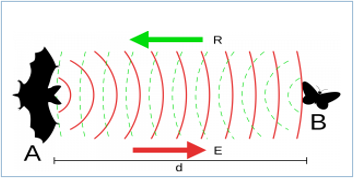
Figure 1: How Bats Use Echolocation. Sound waves (red lines) leave the bat and travel till they hit an object, returning as signal echoes (green lines).
(Image source: WebstockReview.net)
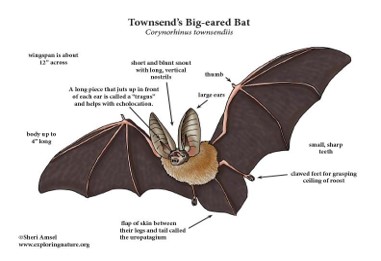
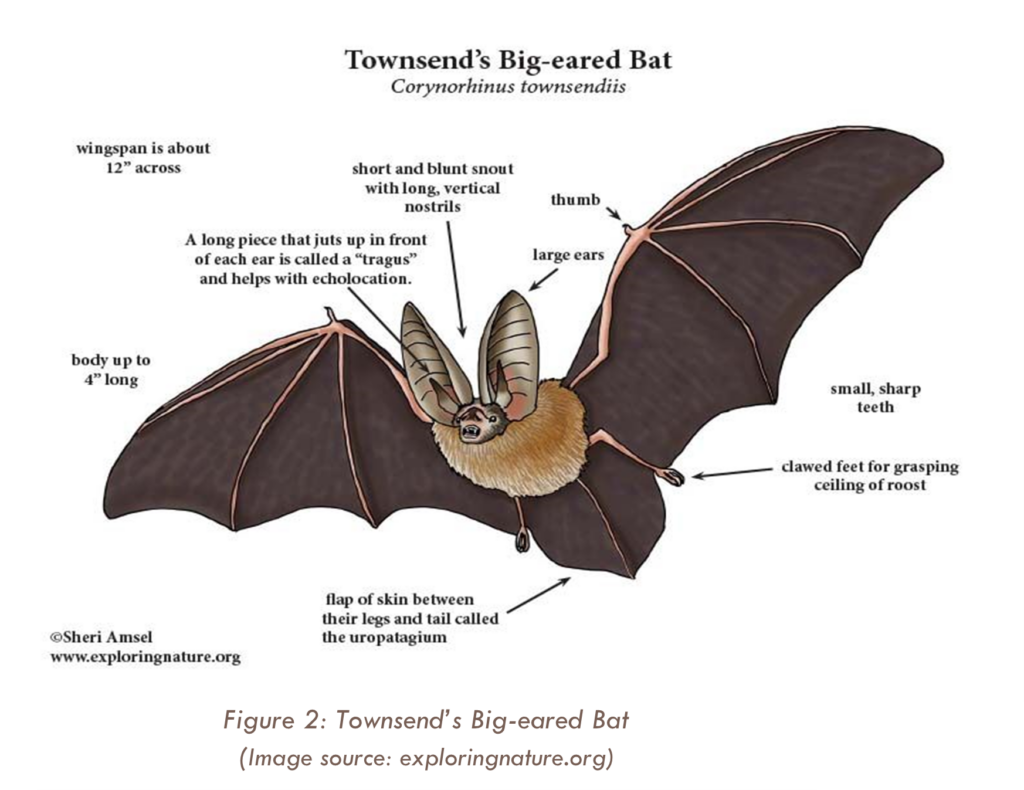
The Townsend’s Big-eared Bat is sometimes called a “whisper” bat because it echolocates at much lower intensities than other bat species using its especially large ears that have a special inner ear sensor called the tragus (Figure 2) to capture sound waves when they fly. Because these ears will curl up when they roost, taking a shape like ram horns, they have been given the nickname of “Ram-eared bats.”
Townsend’s Big-eared bats eat a special group of moths that look for flower nectar at night and can actually “hear” the sonar signals coming from bats. These moths have ears on each side of their abdomen that are “tuned-in” to the same sound frequencies used by the hunting bats. If the moths hear the bat sounds soon enough, they have time to escape and go somewhere else. But, if the bat can get close without being detected, the moths use their “Survival Plan B” to avoid getting eaten. Moths do this in the form of “evasive maneuvers” by flying in random patterns, diving and cartwheeling in the air making it harder for the bats to zero in on the moth’s location.4
Tiger Moths are typically much less attractive to predators because the plants they ate when they were caterpillars contained toxins that make them distasteful or cause discomfort.5 One species in southern Arizona however, is actually quite tasty for bats. The Grote’s tiger moth (Bertholdia trigona) lives for only three to four weeks in the summer, emerging as the monsoon season begins around mid-July. It uses a “Survival Plan C“ by sending out its own ultrasonic clicks that “jam” the signals of approaching bats, causing them confusion and disorientation. But in even a more cunning fashion, it tricks bats into thinking it might be one of the other types of toxic species the bat may have encountered before.6