Water for Wildlife – A philosophical stalemate that could rob the West of its most iconic creatures
May 28, 2021
WATER FOR WILDLIFE…
If the controversy continues, the California desert could lose its most iconic creatures
Mystery at Little Fargo
Dr. Jeff Villepique, wildlife biologist with the California Department of Fish and Wildlife (CDFW), is always on call. He’s just that type of biologist: a hands-on, field ready trooper that has clocked many rugged miles in the name of science. It’s the only way to keep pace with the wildlife he’s studied over 20 years. From his work with black bears in Alaska, to tracking mountain lions and bighorn in the Sierra Nevada, he has gone through many hiking boots and spare tires to get his job done.
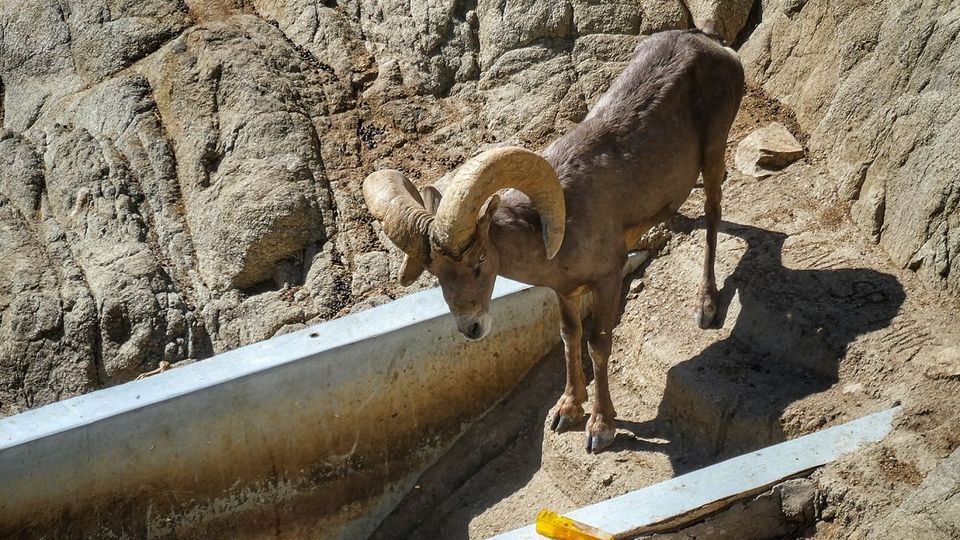
On an early November morning, he’s called out to Joshua Tree National Park to investigate a crime scene of sorts. After changing a flat tire on the front axle and squirting two cans of stop-leak to secure a damaged valve stem on the rear, he gathers his field pack and looks for a safe path around the dry waterfalls of Little Fargo Canyon. Nine bighorn sheep are scattered about in various stages of decay. He collects waypoints on his GPS for each carcass noting age, sex and extent of scavenging. The final animal examined took its last breath some 20 yards from a watering hole.
Almost 10 years ago to the day, Villepique found himself in the very same canyon surveying a similar scene of 6 dead sheep. No other dead species are found in either incident which might have been a sign of water contamination from cyanobacteria or botulism. Only one carcass between the two investigations showed signs of feeding by a mountain lion. From the level of decay, Villepique estimates these animals met their fate sometime late in the summer. His leading hypothesis: each group of sheep waited for the water they were used to finding there – but it never came.
The watering hole is a man-made “guzzler” installed over twenty years ago on a patch of private land within the park. It was developed next to a natural watering hole called a tinaja, a pocket depression in solid rock where rainwater collects until it evaporates or gets used by wildlife. A hidden tank is fed by a pipe snaked to the mouth of the canyon to capture sporadic rainfall from “gully washer” desert storms. Similar systems exist all throughout the desert to capture, store and dispense water to wildlife in the summer months when they need it most. But in years with low precipitation, the tank doesn’t fill up, and the water doesn’t last. Not everyone agrees these synthetic systems are a good idea.
Wilderness without wildlife is only half a wilderness…
Bighorn sheep once shared vast regions of open space with aboriginal man as evidenced by rock art found throughout the Southwest. The songs of the living descendants of those who carved these sheep images in stone over 10,000 years ago are a testament to the cultural significance of this animal. Some believe these drawings, often found near watering holes, were related to hunting magic. Shamans etched the images to increase the chances of a successful hunt because bighorn, with a texture on their feet like Indian rubber, are able to grip and traverse rocky crags no predator can follow.
Bighorn sheep once shared vast regions of open space with aboriginal man as evidenced by rock art found throughout the Southwest. The songs of the living descendants of those who carved these sheep images in stone over 10,000 years ago are a testament to the cultural significance of this animal. Some believe these drawings, often found near watering holes, were related to hunting magic. Shamans etched the images to increase the chances of a successful hunt because bighorn, with a texture on their feet like Indian rubber, are able to grip and traverse rocky crags no predator can follow.
In 1964 a group of California sportsman founded the Society for the Conservation of Bighorn Sheep (SCBS). They spent four years in Sacramento lobbying for the appointment of a State employee to inventory natural water sources and develop a plan to restore bighorn sheep. The job was given to one Richard Weaver who would soon be known to everyone in the sheep world as “Mr. Bighorn.” He assessed 50 different mountain ranges by foot and issued a series of reports that would guide bighorn sheep management to this day. He identified 14 ranges that had nearly all the habitat features sheep required. There was plenty of high quality forage, nice open spaces instead of thick dense tree cover, as well as steep rocky slopes nearby. The only thing missing was reliable water that must have existed before because he found evidence of trails up canyon walls that only a bighorn could have navigated.
Concerns raised around man-made water systems include contamination, mortalities of entrapped animals, increased predation, and interspecies competition that can cause an imbalance in the ecosystem. Many believe that actions focused on one or two species can have unintended consequences that upset the delicate web of life. According to a review of the scientific literature, researchers concluded many of these concerns are not supported by available evidence. Dr. Vern Bleich, retired wildlife biologist with the CDFW and one of the co-authors of the review has spent most of his career working with bighorn sheep. “In my opinion,” says Bleich, “99% of the controversy surrounding the use of artificial water developments for wildlife comes down to a disagreement over where to put them – namely an objection to the presence of anything man-made in designated wilderness.”
Glenn Sudmeier pauses before stepping onto the rocky canyon trail leading to a natural spring. “Let’s wait a moment,” he says with a low voice, “we are about to enter their domain now, let’s do it with respect.” Sudmeier is a hunter-conservationist with over 45 years of service as a volunteer with SCBS and has helped the department install and maintain over 75 different man-made water systems for wild sheep, including the Little Fargo. Sudmeier admits, “I’m no scientist, but if we would just return to wild sheep what we have deprived them of – food, space and water – they would flourish just fine.”
When he hears arguments against man-made water on the grounds that human intervention of any kind is a dangerous game, Sudmeier cites the ongoing recovery story of the California Condor, a species once on the brink of extinction. As part of that recovery plan, deer carcasses were strung across the migration paths of Condors when they were first released into the wild to assist them in learning how to scavenge on their own. Sudmeier sees the use of strategically placed water in the desert to help bighorn recover as being no different. He actually shares the passion of wilderness advocates and agrees “the most amazing landscapes we find in nature must be preserved and protected at all costs, unpolluted by any marks made by man.” But there is a paradox he attempts to put into perspective. “These landscapes are not complete if the native denizens disappear. After all, wilderness without wildlife is only half a wilderness.”
These landscapes are not complete if the native denizens disappear. After all, wilderness without wildlife is only half a wilderness.
Glenn Sudmeier, Society for the Conservation of Bighorn Sheep.
In a landmark ruling in 2010, the 9th Circuit Court of Appeals agreed with his line of thinking.
Paige Prentice, Desert Bighorn Sheep Biologist with the CDFW, works with a team to coordinate the inventory of sheep populations across the ranges Mr. Bighorn first surveyed 50 years ago. She explains the implications of the decision known as the Kofa ruling. “The 9th Circuit deliberated over artificial drinkers in wilderness. The judges ruled that bighorn sheep are in fact a character of wilderness and that wilderness would not be the same without bighorn sheep. Because artificial water sources were proven to be needed to maintain healthy sheep populations, they ruled it was acceptable to have artificial water sources in wilderness.” This ruling applied to a specific group of sheep in Arizona’s Kofa National Wildlife Refuge in a lawsuit first brought forth by Wilderness Watch in 2007.
Living in a warmer, drier world
Wildlife managers now recognize that bighorn sheep populations function as a metapopulation, a notion that Bleich published with colleagues in the early 90s and considers to be his most significant contribution to conservation and wild sheep management. Villepique explains how a metapopulation works, “Distinct populations of sheep occupy independent ranges, but occasionally experience the influx or departure of adult males (usually) or females (rarely) from or to another population.” However, he explains, this desired connectivity can also pose a problem. “When there is a disease outbreak like the one we’re currently tracking through 10 different populations in the Mojave, the connectivity between groups can make it harder to contain the epidemic.”
The disease Villepique speaks of is Mycoplasma ovipneumonia (or M. ovi., for short), a respiratory infection commonly found in domestic sheep and goats. While harmless to the livestock, the pathogen may be fatal to bighorns. Scientists believe the disease spreads via direct or indirect contact. If a bighorn simply rubs noses, nibbles on the same bush or uses the same water as an infected animal, its fate is usually sealed. Critics argue guzzlers create this vector for disease, but Bleich, Villepique and Sudmeier are quick to point out that the risk of disease spread can happen at any water source, natural or artificial. Bleich says, “the risk isn’t the artificial water, it’s the exotic species. That is what management needs to address.”
Sudmeier recalls the time he led Dr. Clint Epps and Dr. John Wehausen down into an unnamed canyon in the Coxcomb Mountains. Epps and Wehausen were collecting sheep pellets to find DNA markers that would map the genetic relationships between isolated sheep groups throughout California as a means to identify the most important migration corridors and linkages between groups. They were also building a model to simulate what will happen to sheep in California in the wake of climate change and increasing segregation of their habitat. Sudmeier took them to a man-made tinaja that was drilled into granite over 40 years ago. They found the skeleton of a female sheep.
“This scenario of dead sheep lying around water that’s unpredictable, I’ve witnessed it a few times in my life and know many other people that have as well,” Sudmeier explains. “All those individual events over many decades tend to culminate in some kind of opinion. And that opinion is the sheep most likely didn’t know of any other place else to go, so why thirst out running across the mountains when they could wait there as they always had, just as their mother had done when she showed them the watering hole in a wetter year.”
Sudmeier is describing something referred to as herd memory, knowledge that social animals like bighorn build over time with each generation learning about their habitat from the one before.
Villepique frames the discussion about water in the context of climate change. “We are looking at a trend of higher average temperatures in the Mojave. As things warm up, evaporation increases, plants dry out quicker at the same time that sheep need more water to keep cool and meet their metabolic needs.” He cites research done by Epps, Wehausen, and Bleich that demonstrated if global average temperatures increase just one more degree, the impact to some bighorn sheep populations could be devastating.
The argument often sparking the greatest emotional response is the notion that agencies only put in water developments to pump up population numbers so hunters can shoot them. “We are not trying to grow sheep just to shoot them – that’s baloney,” Bleich replies. “Water does not increase population density. It does however increase the amount of habitat sheep can use.” Clearly a nerve has been struck. “We must stop the petty bickering soon about if hunting’s right, or hunting’s wrong. Otherwise, there will be nothing left to bicker about in the future.” He explains there are much bigger issues we need to worry about like groundwater, agricultural development, placement of golf courses, and solar projects and highways. “We all need to work together,” he says, “or wildlife is going to be the loser.”
Fireside at Camp Cady
By the glowing embers of the campfire, Bleich strums on the banjo as Mr. Bighorn gets up to say a few parting words to the volunteers and colleagues he worked with for decades. He repeats his well-known mantra that his audience understands all too well, “I’ve always said it, and I’ll say it again. It doesn’t have to be so complicated – with water they flourish, without it they perish.”
So should it really matter how the water got there?